Showing posts with label Headache. Show all posts
Can Gas cause Headaches?

Here is a common query by patients which makes us smile often. Gas causing headaches! 


And you would be surprised that this is a very common query being searched on Google every day.


Have explored the evidence related to it in this brief blog. Your views and comments are welcome. 


If you go through the searches people do on google related to headaches, one very intriguing query that will make you wonder why people have been searching for a correlation between Abdominal Gas and Headaches. 


Is there really a correlation or is it just a piece of misinformation prevalent in the community? Or is it being spread by alternative medicine practitioners carried on with traditional teachings without any scientific evidence? 


Below are the common related keyword searches and the search volumes in India (Source: Ubersuggest):

  • Does gas cause headache - 320 searches per month
  • can gas cause headache - 590 searches per month
  • can gas cause headaches - 260 searches per month
  • can gas cause headaches and dizziness - 90 searches per month
  • does stomach gas cause headache - 30 searches per month
Other related searches
  • can gas problem cause headache
  • why gas causes headache
  • is gas cause headache
  • will gas cause headache
  • headache due to gas during pregnancy
  • how does stomach gas cause headache
  • does gas in stomach cause headache
  • does acidity and gas cause headache
  • can gas cause a headache
  • do gas cause headaches
  • does gas problems cause headaches
  • headache and vomiting due to gas
  • how does gas cause headache
  • can acidity cause headache and vomiting
  • does gas give you headaches
  • does natural gas cause headaches
  • does gas cause migraines
  • can gas cause head pain
  • gas causing headache remedy

What is the direct answer to this popular question?

The answer to this question is NO, the gas cannot directly cause headaches in a normal individual unless you develop air embolism. This is seen in scuba divers when they do a sudden ascent after a deep dive. It can also be seen after head and neck injuries where air can make way into the blood circulation through a bleeding vessel.

However, due to this prevalent belief, there have been many studies that have found that some headaches do get relieved on the treatment of the associated gastric and intestinal disorders (causing gastric discomfort which is perceived as gas).

Gastrointestinal Disorders associated with Headaches

 Gastric and intestinal disorders which cause gastric discomfort (perceived as Gas) and have also been found to have some association to headaches are (1) :
  • dyspepsia
  • gastroesophageal reflux disease (GERD)
  • constipation
  • functional abdominal pain
  • inflammatory bowel disorders (IBD)
  • celiac disease
  • helicobacter pylori (H. Pylori) infection.

Autonomic Aura as a Precursor of Migraine
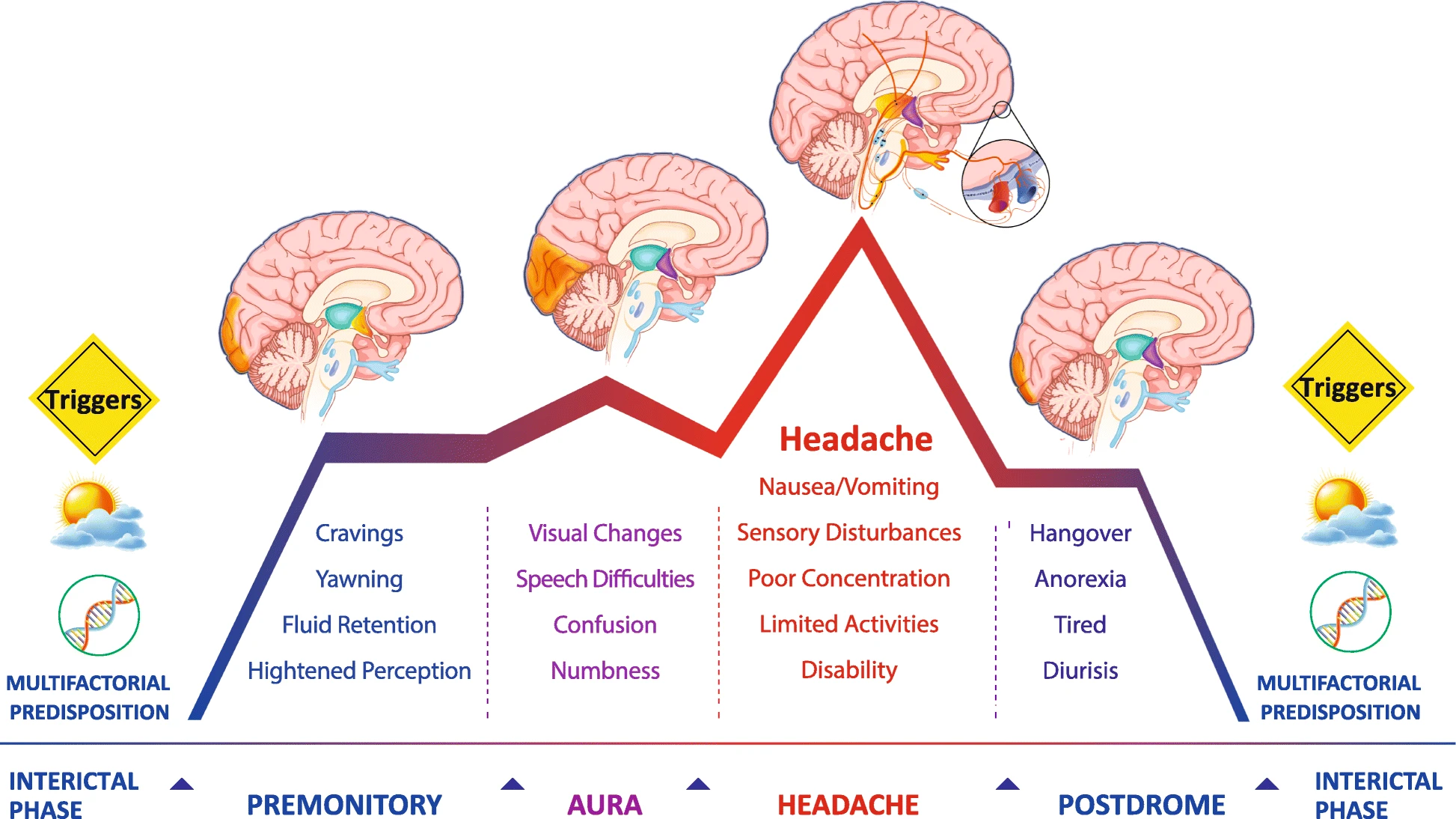
In some studies, it was found that gastric discomfort did not lead to headaches but actually gastric discomfort may mark the start of a migrainous headache and is called an aura. This all happens due to the effect of constriction of brain blood vessels and its effect on the corresponding autonomic area which controls our gastrointestinal system responses.

Different Phases of Migraine and Associated Symptoms
Different Phases of Migraine and Associated Symptoms (Andreou, A.P., Edvinsson, L. Mechanisms of migraine as a chronic evolutive condition. J Headache Pain 20, 117 (2019). https://doi.org/10.1186/s10194-019-1066-0)


Lifestyle or Dietary Factor Leading to Headaches


There are many stimulants that can be a reason for the start of migrainous headaches along with separately causing gastrointestinal symptoms. These include:
  • Stress
  • Not eating on time leading to hypoglycemia
  • Fatigue
  • Lack of sleep
  • Having foods that are known to stimulate an attack of migraines: Dark Chocolate, Cheese, Chinese food, Canned meat, and Alcohol.

Pathways for Headaches in GI disorders

While in another set of studies, for example, treatment of gastroesophageal reflux disease by giving proton pump inhibitors led to the resolution of headaches. In this set of studies, some of the hypotheses which have been proposed for this association are (1):
  • central sensitization and parasympathetic referred pain
  • serotonin pathways
  • autonomic nervous system dysfunction
  • systemic vasculopathy
  • food allergy.
However, still we don’t have an exact answer to how gastric and intestinal disorders can have an effect on the brain. It is an area still open to research to suggest a causal mechanism. But one thing is for sure that human body systems are closely knit together and are likely to have a bigger interplay between them than what we yet understand.

Check out These Top selling Books on Headaches 


Related Posts

History Taking in Neurosurgery : Headache

What are the pain sensitive intracranial structures? Brain itself is pain insensitive.  The following intracranial structures ar...


Hypertensive Pontine Hemorrhage

Contents Case Report Introduction Signs and symptoms Pathophysiology Diagnosis Treatment Hyperte...


References

1. T Noghani, Majid et al. “Gastrointestinal Headache; a Narrative Review.” Emergency (Tehran, Iran) vol. 4,4 (2016): 171-183.


2. Egilius L.H. Spierings (2002). Headache of Gastrointestinal Origin: Case Studies. , 42(3), 217–219. doi:10.1046/j.1526-4610.2002.02054.x 

3. Andreou, A.P., Edvinsson, L. Mechanisms of migraine as a chronic evolutive condition. J Headache Pain 20, 117 (2019). 


History Taking in Neurosurgery : Headache

What are the pain sensitive intracranial structures?

Brain itself is pain insensitive. 

The following intracranial structures are pain-sensitive:
  1. Meningeal arteries
  2. Proximal portions of the cerebral arteries
  3. Dura at the base of the brain
  4. Venous sinuses
  5. Cranial nerves 5, 7, 9, and 10, and cervical nerves 1, 2, and 3

What are the mechanisms causing headaches?

  • Distortion or traction of Dura, Venous Sinuses or Blood vessels: 

    • Drainage of CSF in erect posture causes headache, secondary to traction on the venous sinuses when the brain sinks toward the tentorium as it loses CSF flotation
    • Intracranial mass distorts the dura or the arteries at the base of the brain 
    • Distortion due to raised ICP 

  • Distension of a vessel

    • Distension of extracranial and occasionally intracranial arteries is thought to be the cause of pain in migraine (activate the trigeminal nerve terminals in the vessel wall)

  • Inflammation

    • Inflammation in the subarachnoid space can result in headache. Inflammation can be caused by infection, hemorrhage, or chemical irritation
    • Inflammation of vessel wall by autoimmune process. eg Giant cell arteritis

  • Referral of Pain

    • Lesions above the tentorium - referred pain in trigeminal nerve distribution (the forehead or behind the eye) - because the dura in this region is supplied by the trigeminal nerve
    • Lesions in the posterior fossa
      • referred pain in the ear and the back of the head - because this part of the dura is supplied by cranial nerves 9 and 10 and the upper three cervical roots
      • refer pain to orbit -  termination of orbital (ophthalmic division) pain nerve fibers in the lowest part of the spinal nucleus of the trigeminal nerve, which also receive termination of the upper cervical pain afferent nerve fibers 
      • referred pain to ear - Irritation of cranial nerves 7, 9, and 10 - because the ear has cutaneous supply from each of these nerves as well as cranial nerve 5.

What are the types of Headaches?

For the purpose of history taking, headaches can be divided into two types:
  • Primary- no identifiable cause on examination or investigation and diagnosis is based on  recognizing a pattern, e.g.
    • Migraine
    • Cluster headache
    • Tension-type headache
  • Secondary - definite identifiable cause on examination or investigation, e.g. 
    • Brain tumors
    • Meningitis
    • Sub-arachnoid hemorrhage 
  • 90% - primary headaches, less than 10% are secondary headaches (Rasmussen 1991)

What are the headache "Red Flags"?

  • Worst Headache ever
  • New onset Headache
  • Onset after age of 50 yrs
  • Change in pattern of headache
  • Worsening headache
  • Sudden onset during exertion, sneezing, coughing
  • Headache with postural variation
  • Headache in setting of malignancy or HIV
  • Headache associated with Neurological symptoms or signs
  • Associated with systemic symptoms - fever, weight loss and chronic cough

What history to take in a patient presenting with Headache?


Duration
Exact duration as reported by patient
NEW onset headache or something that has been there since before and has worsened now

Onset ( sudden/ gradual )
Acute onset, severe, first and worst headache, the common possibilities are sub-arachnoid hemorrhage, vascular dissection, pituitary apoplexy
Gradual onset – migraine(mins to days), SDH, GCA(days to months)

Severity
verbal rating scale from 0 to 10

Character
Pulsatile or throbbing or hammering (Raised ICP Headaches/ Migraine)
Dull featureless pain (Tension type headache)
Boring sharp- cluster HA

Time of occurrence
Raised ICP headaches - More in morning, May waken the patient at an early hour

Frequency
Increase in frequency - red flag

Distribution
Frontal or Holocranial - Raised ICP
Band like - tension headaache


Aggravating factors
Exertion, coughing, sneezing, stooping, and straining at stool
Changes in posture (increases in supine - ↑ICP , increases in upright – low CSF pressure headache)

Relieving factors
Improvement on lying flat - low pressure headache

Associated features
Blurring of Vision - Papilloedema
Diplopia, the commonest cause of which is abducens nerve paresis
Nausea & vomiting – migraine, ↑ICP
Neck stiffness – meningeal process
Changes in consciousness
Focal neurological symptoms


References


Topics